
Lumbar care · Available in Morley
Non-surgical spinal decompression
The Flexion Distraction table is a specialised chiropractic tool that creates gentle, rhythmic traction through the lumbar spine. No twisting, no cracking, no sudden movement. Perfect for disc pain, sciatica, or patients with excessive compression on the lumbar nerve roots.
Book a lumbar assessment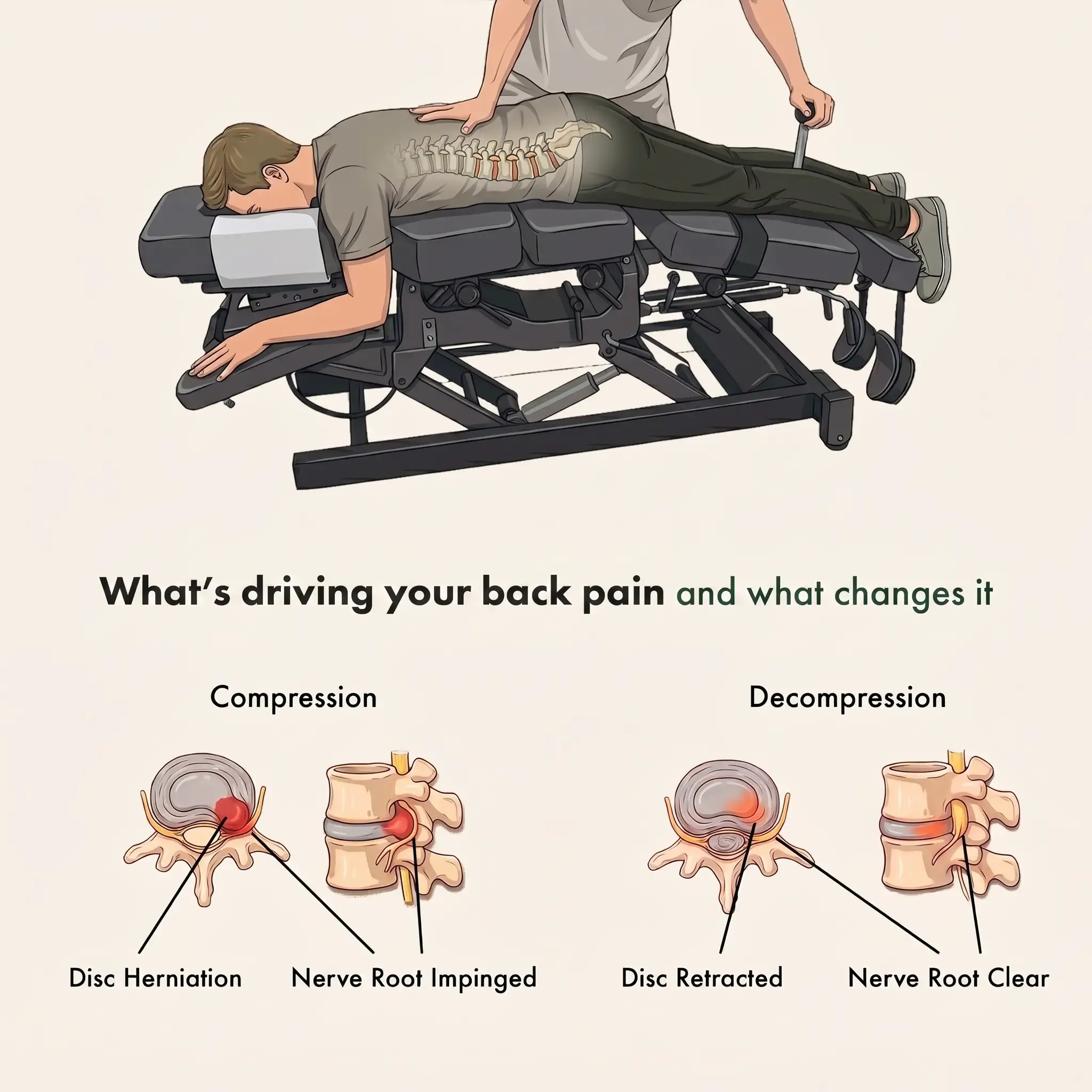
How flexion distraction works
Simple mechanics. Gentle by design. Evidence-supported.
-
You lie face-down and relax
You're positioned comfortably on a specialised segmented table. Nothing is asked of you: the treatment is entirely passive. Many patients find it deeply relaxing.
-
The table creates gentle traction
The lower section of the table moves in a slow, rhythmic motion, creating a decompressive force through the lumbar discs. There is no twisting, no sudden movement, and no forceful manipulation at any point.
-
Disc pressure gradually reduces
The technique widens the spinal canal, reduces intradiscal pressure, and stretches the surrounding spinal musculature. Over a structured course of sessions, this mechanical decompression addresses disc bulge and nerve root irritation at the source.
Is this technique right for you?
Who flexion distraction suits
-
Disc-related lower back pain
Pain that persists beyond 2 weeks and hasn't improved with rest alone. Often indicates disc loading rather than simple muscle strain.
-
Sciatica and referred leg pain
Pain travelling into the glute, hamstring, or foot, indicating nerve root involvement. One of the primary presentations this technique addresses.
-
Nervous about chiropractic adjustments
No cracking, no twisting, no sudden movement. Patients who've had poor experiences with traditional manipulation elsewhere often respond well to this approach.
-
Chronic lumbar stiffness
Long-term stiffness and restricted mobility that worsens with prolonged sitting or standing. The rhythmic traction helps restore segmental movement over time.
-
Complex or post-surgical cases
Suitable where high-force manipulation is contraindicated, including seniors, post-surgical presentations, and patients with osteoporosis or fragile presentations.
-
Pain worse after sitting
A key indicator of disc loading. If your lower back pain reliably worsens after prolonged sitting, flexion distraction is specifically designed for this pattern.
The research behind the technique
Flexion Distraction, developed by Dr. James Cox, has been studied extensively in chiropractic and rehabilitative settings. The evidence base supports its use for lumbar disc herniation, nerve root compression, and associated radiculopathy. Research published in the Journal of Manipulative and Physiological Therapeutics demonstrates meaningful improvement in pain and disability scores over a structured course of care.
Mechanically, the technique reduces intradiscal pressure, widens the spinal canal cross-sectional area, and reduces nerve root tension, a rationale well-supported in the peer-reviewed literature. For patients weighing non-surgical options, flexion distraction represents a structured middle ground between passive waiting and more invasive intervention.
Individual results vary. We do not guarantee specific outcomes. A thorough assessment is required to determine whether this technique is appropriate for your presentation.
One of the few clinics in the corridor with this table on site
Bassendean Chiropractic is located at 254 Beechboro Rd, Morley, bordering Bassendean. We serve patients from Beechboro, Embleton, Kiara, Noranda, Bayswater, Eden Hill, Ashfield, and Lockridge. The Flexion Distraction table is a primary tool in our lumbar care approach, not an add-on. If you've been managing lower back pain or sciatica and feel stuck, a proper assessment is a practical next step.